Multirobot Collaborative Monocular SLAM Utilizing Rendezvous

Multirobot Collaborative Monocular SLAM Utilizing Rendezvous

Published: by
Yunwoo Lee

Multirobot Collaborative Monocular SLAM Utilizing Rendezvous

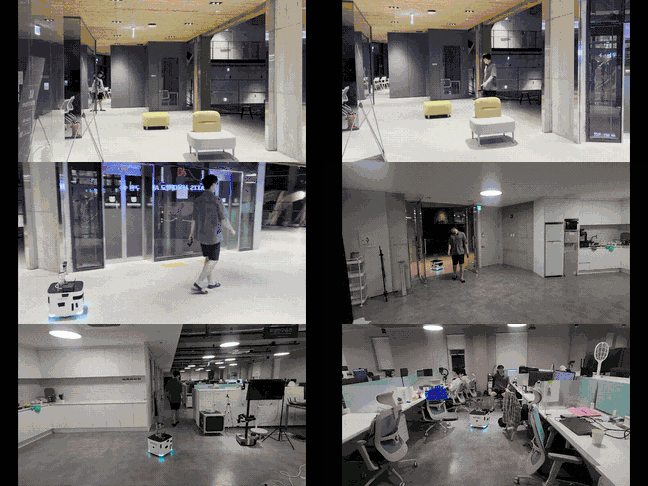
Multi-robot teams can build a shared map faster than any single robot, but fusing each robot’s map usually calls for extra sensing to register them against one another. This work proposes a collaborative monocular SLAM system, including a map-fusion algorithm, that instead exploits rendezvous — moments when two team members come within view of each other during normal operation — using only a monocular camera on each robot, with no additional sensors required.

Received the 27th Samsung Human-Tech Paper Award (Silver Prize). Published in IEEE Transactions on Robotics, 2021.

SLAM

Latest Research

QP Chaser: Polynomial Trajectory Generation for Autonomous Aerial Tracking

Maintaining the visibility of the target is one of the major objectives of aerial tracking missio...

DMVC-Tracker: Distributed Multi-Agent Trajectory Planning for Target Tracking Using Dynamic Buffered Voronoi and Inter-Visibility Cells

This letter presents a distributed trajectory planning method for multi-agent aerial tracking. Th...

Decentralized Trajectory Planning for Quadrotor Swarm in Cluttered Environments with Goal Convergence Guarantee

Decentralized multi-agent trajectory planning (MATP) can enhance the efficiency of multi-robot sy...